HDPE Butt Fusion Pressure Explained: How to Read the Pressure–Time Curve
During HDPE butt fusion, the pressure gauge tells you what the machine is doing. Pressure rises to form a bead, drops while the pipe ends absorb heat, then rises again to join the heated ends. The machine holds that joining pressure while the joint cools in the clamps.
The diagram below shows how these stages fit together in the ISO 21307 single low-pressure (SLP) procedure.
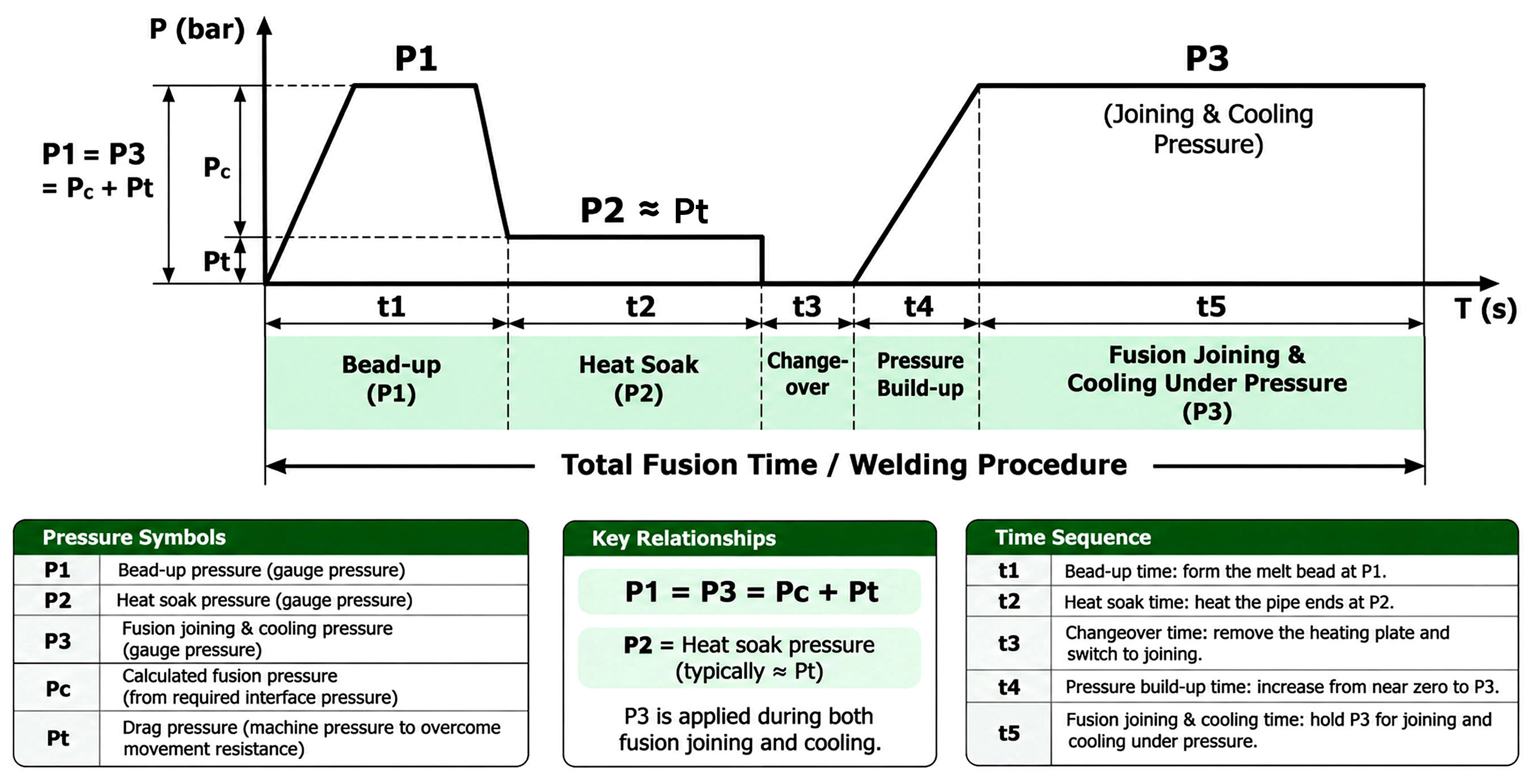
The vertical axis shows hydraulic gauge pressure, and the horizontal axis shows elapsed time.
The Five Stages of the Pressure–Time Curve
| Stage | What happens at the pipe ends | ||
t1 — Bead-up (P1) | The pipe ends are pressed against the heater plate until a bead of the required size forms around each end. | ||
t2 — Heat soak (P2) | Pressure is reduced while the pipe ends remain in contact with the heater plate. Heat continues to penetrate the pipe wall. | ||
t3 — Changeover | The carriage opens so the heater plate can be removed. | ||
| t4 — Pressure build-up | The heated pipe ends are brought together, and hydraulic pressure rises to the target joining pressure, P3. | ||
| t5 — In-machine cooling (P3) | The joint stays clamped at P3 for the specified cooling time. | ||
Why Bead-Up and Joining Use the Same Gauge Pressure
In the single low-pressure procedure shown here, bead-up and joining use the same target gauge pressure. That target includes two components.
· Pc — Calculated hydraulic pressure. This is the gauge pressure needed to produce the required force at the pipe ends. It is calculated using the specified interfacial pressure, the cross-sectional area of the pipe wall, and the effective area of the hydraulic cylinders.
· Pt — Measured drag pressure. This is the gauge pressure needed to overcome the resistance of moving the carriage and the pipe it holds.
Adding the two gives the target reading on the machine’s pressure gauge.
P1 = P3 = Pc + Pt
Why Heat Soak Pressure Can Be Lower Than Drag Pressure
Measuring drag pressure involves moving the carriage and the pipe. During heat soak, the pipe ends are already against the heater plate. The machine only needs enough pressure to keep them in contact.
Under ISO 21307 SLP, P2 is the lowest pressure that keeps the pipe ends in contact with the heater plate, up to the current drag pressure. The diagram shows P2 close to Pt as an example. On a given setup, P2 can be lower.
If the gauge reading rises briefly at the start of heat soak and then settles, record when it happens along with the machine model, pipe diameter, and SDR. That context makes it easier to compare pressure traces from different setups.