FX Series Butt Fusion Machines: Practical Standard Accessories
In a butt fusion welding system, the equipment is typically composed of core components and accessory configurations.
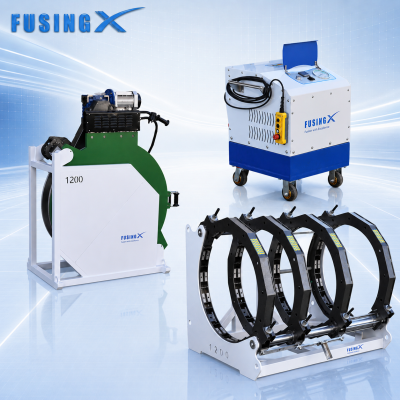
The machine frame, facer, heating plate, and hydraulic unit are essential core components required to complete the welding process and together form a complete butt fusion system.
In this article, “standard accessories” refers to the auxiliary configurations beyond the core components, designed to improve adaptability, safety, and convenience in real job-site conditions.
During the design of the FX series, we follow a clear principle:
Only accessories that are repeatedly and inevitably used on real construction sites are included as standard.
1. Standard Accessories for Pipe Diameter Adaptability
The FX series is equipped with modular clamp inserts as standard, allowing the machine to adapt to different pipe diameters within its working range.
The purpose of this design is not complexity, but to reduce the inconvenience of repeatedly changing complete clamp sets and to improve efficiency when switching between pipe sizes.
In practice, clamp inserts are not only about holding the pipe, but about maintaining stable and repeatable alignment during repeated clamping operations.
2. Auxiliary Configuration for System Stability
An accumulator is included as a standard configuration in the FX series to enhance hydraulic system stability during operation.
In large-diameter welding applications, the system is often subjected to continuous and repeated loads. The accumulator helps smooth system response and reduce uncertainty caused by pressure fluctuations.
Although this configuration may not stand out in technical specifications, its value becomes evident during long-term engineering use.
3. Practical Accessories Based on On-Site Operating Habits
The FX series is supplied with support shoes as standard, assisting with pipe or component support and movement during on-site operations.
While these accessories are not directly involved in the welding process, they significantly reduce operator workload and improve workflow continuity during positioning and adjustment.
Their value lies not in complexity, but in how well they fit real job-site practices.
4. Protective Accessories for High-Contact Areas
Wear-resistant metal plates on the upper ring are included as standard to reduce wear in high-contact areas during long-term use.
This protective design does not alter the welding process but helps extend the service life of key structural components, making it more suitable for continuous, high-frequency engineering applications.
5. Enhanced Accessories for Larger Sizes (800–1200 Models)
For FX series machines in the 800–1200 size range, certain accessory configurations are further reinforced to meet higher loads and more demanding job-site conditions.
For example, anti-slip pad blocks are added to the upper and lower rings to improve stability when clamping larger pipes.
At the same time, the facer clamping mechanism is optimized for higher frequency and heavier-duty facing operations.
In addition, a gear-driven facer solution for larger sizes is currently under development and will be introduced to further improve transmission stability in large-diameter applications.
Conclusion
The FX series does not aim to include every possible accessory as standard. Instead, each configuration is carefully evaluated based on one key question:
Which accessories would repeatedly cause inconvenience if they were missing on real job sites?
From modular clamp inserts and accumulators to support shoes, wear-resistant plates, and size-specific reinforced configurations, these standard accessories together define the practical, job-site-oriented experience of the FX series.

📘 Read More from Product Knowledge
• Back to Product Knowledge
• Next: Applications of HDPE Butt Fusion Machines in Pipeline Engineering